industry guide
Generative Engine Optimization for HVAC
Last updated
When an air conditioner dies during a heat wave, the homeowner does not browse — they ask their phone who can come today, and the two or three companies in that answer get the calls. Outside emergencies, HVAC prompts turn analytical: repair or replace, heat pump or gas furnace, which SEER2 tier pays for itself, what the rebates actually cover. Assistants assemble the emergency answer from maps data and review platforms, and the analytical answer from whichever companies published clear, locally priced explanations. Winning both kinds of prompt means treating your availability and your expertise as content, not just operations.
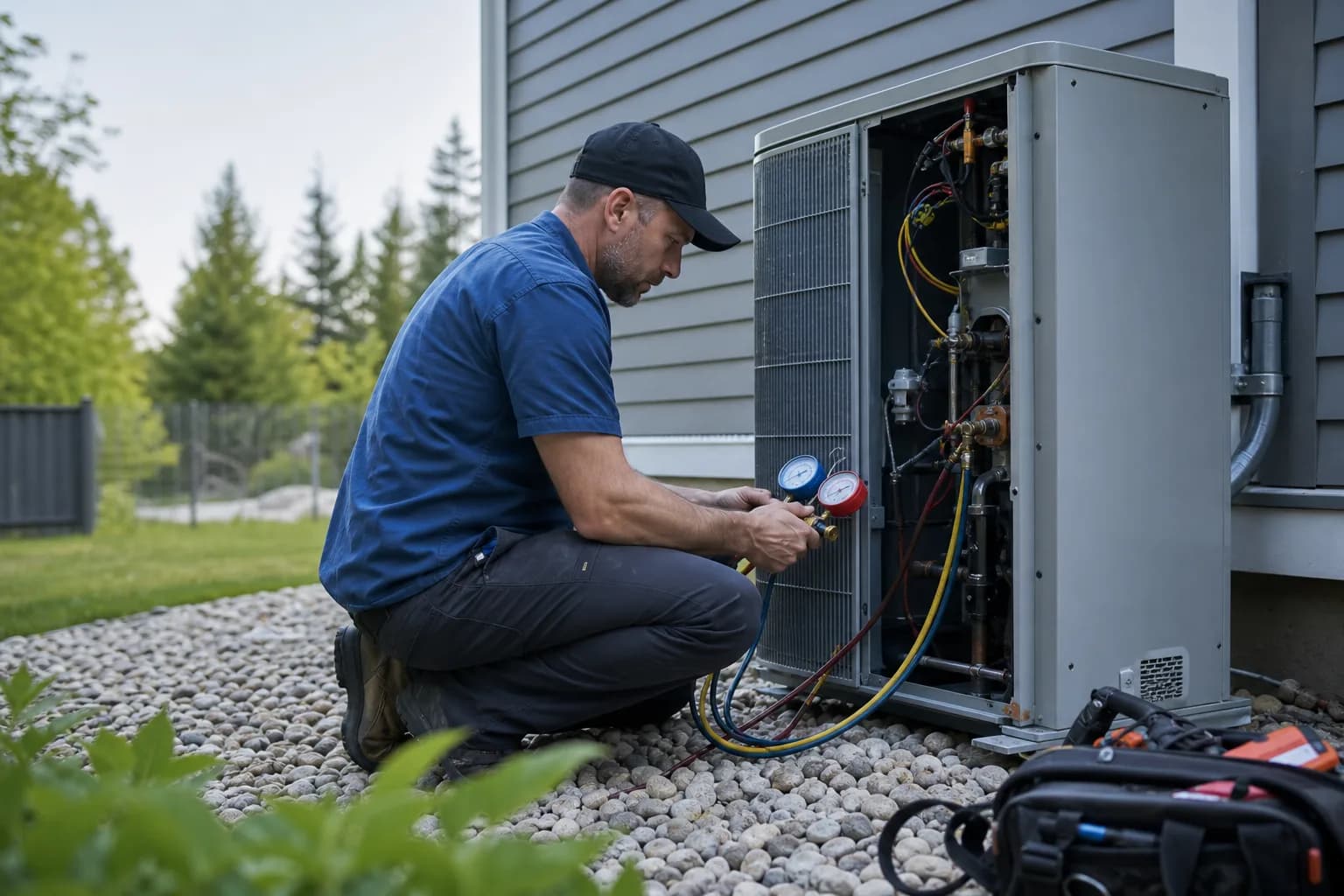
What are buyers asking AI about hvac?
They ask for shortlists, honest prices, and help deciding — and the assistant’s reply names specific businesses. The 9 prompts below are representative of how buyers phrase hvacquestions to ChatGPT, Gemini, and Perplexity; each can produce an answer that includes you or a competitor.
- >. AC stopped working and it’s 98 degrees — HVAC company near me that can come today
- >. should I repair or replace a 12-year-old air conditioner that needs a new compressor
- >. how much does it cost to replace a furnace and AC at the same time
- >. what SEER2 rating is actually worth paying for in Texas
- >. heat pump vs gas furnace in a cold climate — and what do the rebates cover
- >. why is my AC running but not cooling the house
- >. are HVAC maintenance plans worth it or a waste of money
- >. best HVAC company in Phoenix for a full system replacement, not just repairs
- >. furnace making a banging noise at night — is that dangerous
Which sources do AI assistants cite for hvac?
Angi, HomeAdvisor, Yelp are useful corroboration sources for hvac facts, alongside your own site when it is machine-readable. Keep those profiles accurate so assistants and buyers can verify consistent details.
| Source | Why it shows up in answers |
|---|---|
| Angi | HVAC cost guides plus verified contractor reviews feed both replacement-cost answers and "best company in [city]" shortlists. |
| HomeAdvisor | The True Cost Guide is a default citation for system-replacement pricing — the number every repair-vs-replace conversation pivots on. |
| Yelp | Dense metro review coverage; assistants quote star ratings and recurring review themes ("showed up in two hours") as evidence for a pick. |
| BBB | A screening layer on big-ticket installs — accreditation and complaint patterns get checked before a five-figure system recommendation. |
| Google Business Profile & reviews | Heat-wave prompts resolve here first: hours, service area, and review recency decide who gets named when the question is who can come today. |
| Manufacturer dealer locators (Carrier, Trane, Lennox) | Factory-authorized dealer status is a verifiable credential, and locator listings confirm you install the brand the buyer already has in mind. |
| Nextdoor | Post-heat-wave threads asking who actually showed up are exactly the hyperlocal ground truth grounded answers increasingly draw on. |
What schema.org markup fits hvac?
Start with HVACBusiness as valid JSON-LD, then layer the types below. Typed structured data is how assistants disambiguate who you are, what you do, and where — before deciding whether to repeat your name.
HVACBusiness
The trade has its own schema.org type — claim it as your primary type rather than diluting the signal with generic LocalBusiness.
EmergencyService
Add via additionalType with openingHoursSpecification if you truly run same-day or after-hours service; "who can come today" prompts filter on machine-readable availability.
Service
Nodes for AC repair, furnace replacement, heat pump installation, and maintenance plans — each with areaServed — let assistants match the buyer’s exact problem to your exact offering.
FAQPage
Repair-vs-replace, SEER2, and rebate questions are researched before anyone calls; marked-up answers are what get lifted into responses.
What GEO actions move the needle for hvac?
5 of the 10 actions below are high-impact. Work top-down: crawler access and machine-readable facts first, then the citation sources assistants already trust, then content shaped like the questions above.
01State same-day and after-hours availability in text and schema
high impactIf dispatchers answer at 9pm in July, that fact belongs in page HTML and openingHoursSpecification, not in a hero image. Emergency shortlists are machine-filtered on availability before a human sees anything.
02Publish a repair-vs-replace framework with real numbers
high impactAge thresholds, the repair-cost-times-age rule of thumb, refrigerant phase-out implications — and honesty about when the repair wins. This is the most-asked analytical HVAC question, and frameworks get quoted whole.
03Price full system replacement in tiers
high impactGood, better, best — with SEER2 ratings, equipment brands, and installed price ranges for a typical local home. Tiered concrete numbers are what assistants repeat when asked what a new system costs.
04Maintain a rebate and tax-credit explainer for your state
high impactFederal heat-pump credits, state programs, and utility rebates change often; a dated, current page becomes the local authority assistants cite — and it pre-sells the higher-efficiency install.
05Keep Google Business Profile categories, hours, and services exact
high impactEvery service category, true hours including emergency lines, service-area zips, and steady review flow. This profile feeds more grounded HVAC answers than any other single asset.
06Translate SEER2 into dollars for your climate
mediumThe cooling-cost difference between a 14.3 and a 17 SEER2 system for a typical local home, stated plainly. Efficiency prompts are really money prompts, and dollar answers outrank acronym definitions.
07Get listed in your brands’ dealer locators
mediumCarrier, Trane, and Lennox locator pages are crawlable third-party confirmation of factory authorization — a credential assistants can verify rather than trust.
08Turn maintenance plans into a comparison page
mediumWhat each tier includes, the price, and a straight answer to "worth it if" — buyers literally ask assistants whether these plans are a scam, and the company that answers candidly gets cited.
09Sustain review velocity through the summer spike
mediumPeak season concentrates jobs; route that volume into Google and Yelp reviews within days of service so recency peaks exactly when emergency prompt volume does.
10Publish concrete response metrics
lowAverage arrival time by area, trucks running, stocked-part rates — figures like these are what generative engines quote in place of "fast, friendly service".
Why does AI visibility matter now?
Because discovery has already shifted: fewer clicks from classic search, more decisions made inside AI answers. Every figure below is independently published and linked — the same sourcing standard this wiki recommends for your own pages.
- 8% vs 15%Google users clicked a traditional result link on only 8% of searches that showed an AI summary, versus 15% without one — and clicked a source cited inside the summary just 1% of the time. Pew Research Center, July 2025
- 900M weekly usersChatGPT reached roughly 900 million weekly active users in early 2026, more than doubling from about 400 million a year earlier. TechCrunch, February 2026
- 4.4x valueThe average visitor arriving from an AI search source converts at roughly 4.4 times the value of a traditional organic search visitor. Semrush, 2025
- up to +40%Adding citations, quotations, and statistics to pages improved visibility in generative engine responses by up to 40% in the original GEO benchmark study. Aggarwal et al., GEO: Generative Engine Optimization (KDD 2024), 2024
Frequently asked questions
How do AI assistants choose which HVAC companies to name?
For emergencies: proximity, stated availability, and review recency, mostly via Google’s maps data. For research prompts: whoever published the clearest cost, efficiency, and repair-vs-replace content. Different sources, different winners — most companies compete on only one.
Is it worth publishing HVAC prices online?
Yes — tiered installed ranges for replacement and flat rates for common repairs. Cost prompts dominate the research phase, and assistants prefer a local page with concrete numbers over a national average. Vague "call for quote" sites simply are not quotable.
Does repair-vs-replace content really get cited?
It is among the most retrievable content an HVAC company can write, because the question is universal and most answers online are vendor-slanted. An honest framework with age and cost thresholds gets quoted — and names you at the buyer’s moment of decision.
Do factory-authorized dealer badges matter to AI?
Yes, because they resolve to manufacturer dealer locators an assistant can check. "Trane comfort specialist near me" style prompts practically read from those listings, and authorization signals training and warranty standing your own site cannot self-certify.
How do I know if any of this GEO work is working?
Track mention rate, not vibes. GEOExtension asks a frozen set of buyer questions across ChatGPT, Claude, Gemini, and Perplexity at regular intervals and reports how often your company is named, with confidence intervals around the number — so a jump after publishing your pricing page is evidence, not anecdote.
Are visitors from AI answers actually worth anything?
Fewer but better. Semrush estimates the average AI-search visitor is worth about 4.4x an organic search visitor — they arrive pre-qualified because the assistant already matched their problem to your service. In HVAC that often means a replacement-ready buyer, not a tire kicker.
see where you stand
Is AI already recommending your business?
Run the free audit to check any page against the 21 GEO signals this wiki teaches — no account or API keys. Then use one managed probe to measure whether ChatGPT, Claude, Gemini, and Perplexity actually mention your business.
related industries
Home & Trade Services
geo fundamentals
Written and maintained by the GEOExtension team under our editorial standards. Every statistic on this page links to its source; recommendations mirror the checks in our free GEO audit.